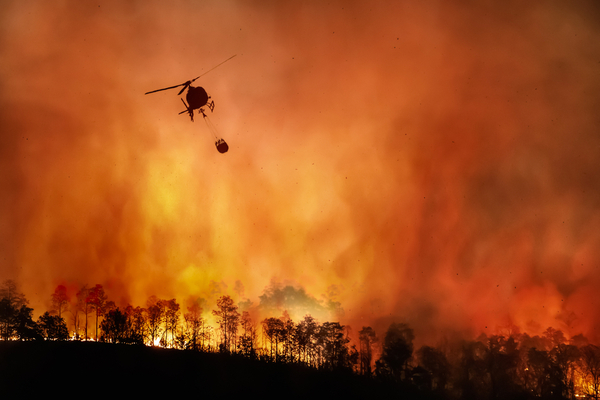
Daniel Swain, a climate scientist at the University of California at Los Angeles, said the transition period between winter and spring is usually when the Plains states tend to experience their wildfire season. But there have been some unusual trends in recent fire activity there. “Even if there is still a relative lull in the winter, it’s not as deep a lull as used to be,” Swain said in an interview with CNN, noting that scientists are “seeing periods in the winter which used to have virtually zero fire risk, in some places now having appreciable fire risk, in some cases.”
Climate researchers have said two major factors have contributed to the West’s multiyear drought: the lack of precipitation and an increase in evaporative demand, also known as the “thirst of the atmosphere.” Warmer temperatures increase the amount of water the atmosphere can absorb, which then dries out the landscape. That’s also true for places like Colorado and interior Texas, away from the Gulf Coast, Swain said. When the atmosphere extracts moisture from the soil without returning that water in the form of precipitation, there’s going to be less water available to those plants.
“And that’s the main climate change connection — the effect that the warming and drying is having on the vegetation aridity itself,” Swain said. “In most cases, the drier vegetation becomes, the more flammable it becomes. In some cases, it’s an exponential relationship where each additional increment of drying makes it increasingly more flammable at an increasing rate,” said Swain, adding, “That’s why even a few degrees of warming can make a big difference.”
In August of 2021, the UN Intergovernmental Panel on Climate Change
released a report stating that because of the climate crisis, droughts that may have occurred only once every decade or so now happen 70% more frequently. Since the 1970s, parts of Texas and the West have seen a doubling or tripling of the number of fire weather days, according to an
analysis by Climate Central. “The commonality that we’re seeing across most fire-prone regions on Earth is an increase in the number of extreme fire weather days, and also an increase in the magnitude of the very worst severe fire weather days,” Swain said. “And that is linked to human-caused climate change.”
—
Photo Credit: Toa55 / Shutterstock.com